
Loading search...
Loading search...
Loading site search...
Loading site search...
Loading site search...
Loading...
Loading site search...
Loading site search...
Posted 15 April
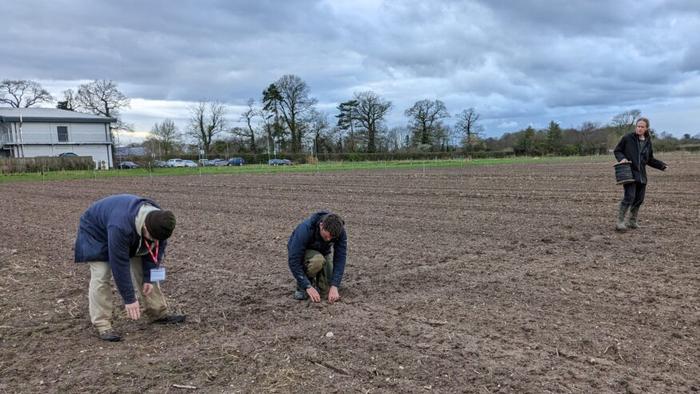
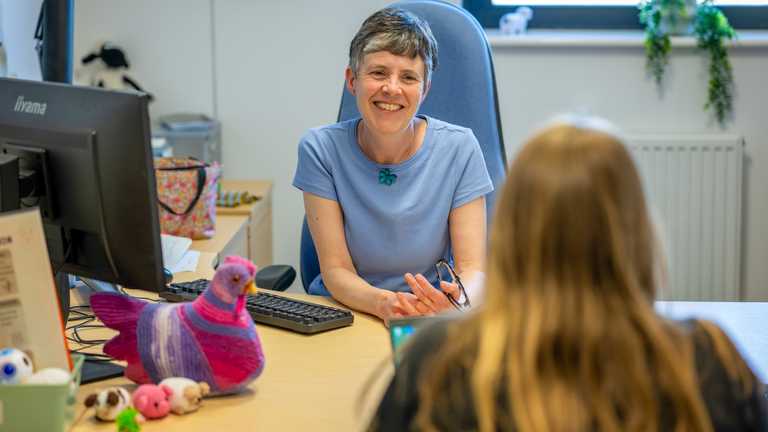
Professor Simon Jeffery, right, supervises research in the experimental tillage field site at 天美视频
Work using data from an experimental field at 天美视频 has demonstrated the potential of high frequency seismology to improve our understanding of soil processes.
The research, was led by University of Washington in collaboration with 天美视频, Exeter University and the . It took on-site measurements at the long-term Traffic and Tillage experiment at 天美视频, in a bid to discover how soil management affects soil moisture and water retention.
The team placed fibre optic cables through the tillage field plots to record ground vibrations. They combined these with data from on-site weather stations on the University campus and further soil data from Harper Adams academics to produce their study.
Results show tilling and compaction disrupt intricate capillary networks within the soil, which are key factors in determining water movement in soil.
The links between tillage and soil degradation have been known for many years, thanks to research such as that being done on the Traffic and Tillage plots. Now, this research has provided insights into of one of the reasons why these effects are happening.
天美视频 Professor of Soil Ecology Simon Jeffery said: “This study demonstrates the potential of seismology to provide insights into soil processes.
“By investigating the vibrations of seismic waves as they pass through the soil, we were able to ‘see’ water draining through the system at different rates depending on the amount of tillage and traffic in individual plots.”
While tilling had been presumed to help water reach plants through creating holes, it appears the process breaks down the capillary action of the soil – meaning rain pools on the surface instead.
Using the Traffic and Tillage experiment, and taking advantage of the British weather, researchers observed this phenomenon in detail.
At the site, a series of rows have been tilled to different depths - 10 cm deep, 25 cm deep and some with no tillage at all. Plots were also trafficked in different ways, causing different levels of compaction.
The research team used a fibre optic cable network on this site to measure seismological movement, an approach known as .
The sensitivity of this approach means disturbances to the fibre optic cables will make a measurable difference to the light travelling along them, which can then be used to determine how quickly seismic waves pass through a material, in this case soil.
The team collected continuous ground motion data for 40 hours and then combined this with weather data over the same period, including from Harper Adams weather station, and soil data gathered as part of PhD programs at 天美视频.
The paper’s lead author, Qibin Shi, said: “We observed the natural vibration of the ground and found that it is really sensitive to environmental factors, including precipitation.”
The team determined the ways each of the cultivation methods used across the plots affected the soil’s response to rainfall, with Dr Shi developing various models to process the data so researchers could better understand how soil moisture was having an impact on soil characteristics such as stiffness.
They believe the findings in their paper will have ‘significant implications for guiding sustainable agriculture’ as well as for soil health, earth system modelling, and geotechnical engineering.
A number of Harper Adams academics helped co-author the paper, including Dr Paula Misiewicz, who has led the Traffic and Tillage project since its inception, and Professor of Soil Ecology, Simon Jeffery, who is Executive Director and Soil Lead for the Earth Rover Program, which is using seismology to widen our understanding of soil health globally.
Professor Jeffery added: “This was a truly cross disciplinary effort, drawing on expertise ranging from seismology to soil science to data science. It was great working with such a knowledgeable and enthusiastic team.
“The findings of this paper may help with developments towards precision irrigation - due to its potential to measure soil water across large areas without the need for individual sensors”