A field trip with a difference – to South Africa – has been undertaken by 26 final-year 天美视频 students, with .
The students were from a range of different courses including Zoology, Wildlife Conservation, Animal Behaviour and Welfare, Bioveterinary Science and Veterinary Nursing.
This guest blog by Senior Lecturer Dr Ellen Williams is about their unforgettable time in the African Bush.
After a long trip from the UK to Johannesburg (with a brief stop at Doha airport where we got to see the most amazing indoor forest!) we arrived at .
It had taken the best part of a full day, but the students were in incredible spirits. We arrived at the gate a bit earlier than anticipated and while we waited for the team at to come and collect us we were lucky enough to see some of the African plains animals hanging out by the first watering hole – zebra, wildebeest and for those with a keen eye, giraffe on the horizon and a tiny little invert on the fence!

The incredible forest inside Doha airport
Every group we bring to South Africa is always unique, they always put their own spin on things, and this group were no different. Their passion for everything from the tiny creatures to the huge, and their frankly incredible eye for spotting things was infectious!

The adventure begins, students land in Johannesburg airport – despite the long journey everyone was so excited for the next two weeks!
We settled into camp in day one – students buddied up and were shown to their tents. The first of many fabulous open-air showers awaited them. We started the evening with a quick safety briefing and then induku, where everyone took it into turns to hold a stick and talk about what they wanted out of the experience. The safety briefing, incidentally, is where this blog got its name: Graeme, Camp Manager for Wild Connection Research had told the students not to touch things they didn’t know, to call for help if they needed it etc.
Saffron, one of the Animal Behaviour and Welfare students, then started to say what we can only assume was ‘what should we do if we break something’ and combined that with ‘what if we see a snake?’
Merged together, the question was one I for sure have never heard before: ‘what if we break a snake?’. An excellent question!
Graeme answered that with pretty sage advice: ‘Don’t break a snake!’
So there we had it, students knew, 100 per cent, they should not break a snake!
The week at Nambiti Game Reserve was action-packed. After being split into three groups for the week, we were given our schedule a couple of days ahead of time. We were accompanied by an amazing team of guides who gave us so much knowledge and shared so many of their experiences. This is just a very brief run-down of the amazing things we got up to!
Methods for tracking animals: Radio tracking and animal tracks and signs
The bush tells you an unbelievable amount about the animals and being alert for tracks and signs is the key to understanding what is happening. A track can tell you when (approximately) an animal passed through the area, which way they were headed, the approximate size of the animal and many other things. They can also help when technology fails! The guides were incredible and we saw many tracks including jackal, genet, hippo, giraffe, duiker, zebra, wildebeest, porcupine, mongoose and even frogs! We also saw the scratch marks of a mud wasp, which was very sweet! The students learnt lots here, including how to differentiate domestic dogs from jackal and cats from dogs. Nambiti provides an opportunity to learn such a lot and seeing them embrace this opportunity was really amazing!
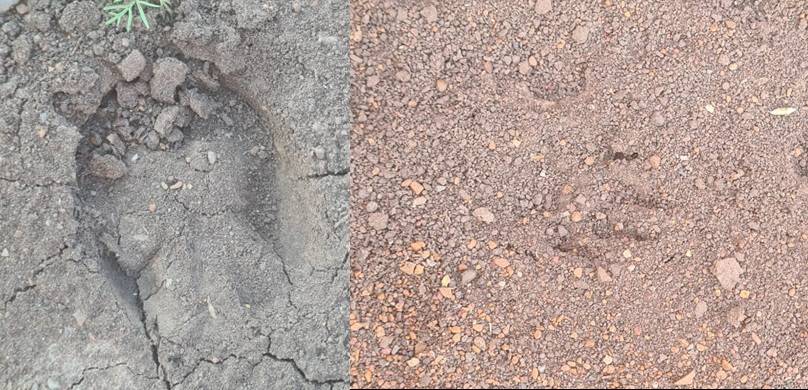
A zebra track (left) and a white tailed mongoose track (right)
There are also opportunities to use technology to monitor animals and at Nambiti they use radio telemetry.
Some of the Harper students were already familiar with radio telemetry but tracking an animal in the bush is very different to tracking a collar in a relatively small woodland at Harper Adams. There was a small competition between the three groups to see which group could track a lion collar fastest! This wasn’t attached to an actual lion so this did make it a bit more challenging, but the students still tracked it down to a tree – using some of the skills they had learned in animal tracking to help – they knew a human had put it out so they were monitoring foot prints and grass movement to give an idea of the path that had been taken!
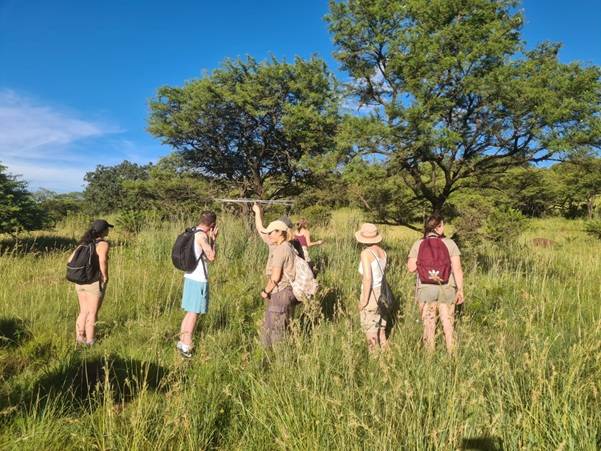
One of the groups radiotracking – there was a competition across the three groups to see who could locate the collar the fastest!
Priority species monitoring
A key element of the work of the research team at Nambiti game reserve is priority species monitoring. The priority species at Nambiti game reserve, with the exception of rhino, are tracked using radio collars. A key component of monitoring the priority species is tracking them to make sure they are well – this involved using telemetry equipment to locate the target animals (including lions and cheetah) and then undertake a body condition assessment, which allows an understanding of whether any additional monitoring needs to be undertaken.
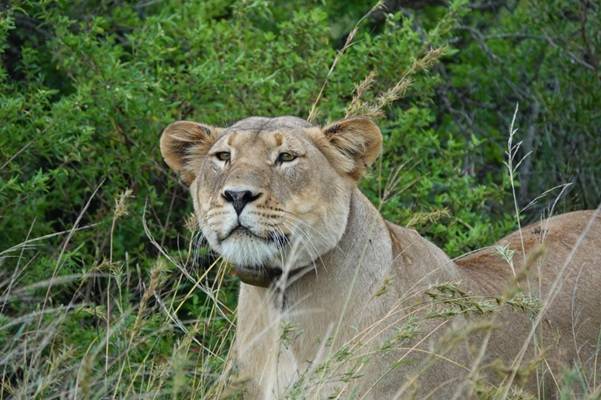
Here you can see the collar under the lion's chin. An adult female at the reserve, she is in really good condition. Photo credit: Saffron Banks
The students also had an opportunity to undertake some research looking at the interactions between the cheetah and the lion at Nambiti. This is important in reserve management as if the reserve goes over their carrying capacity for any species there is the possibility of negative implications - including disruption to ecological functioning. The research involved monitoring lion behaviour and then recording where the nearest cheetah were, to try to understand proximity at the time of monitoring.
Anti-poaching unit walk
A constant challenge in reserve management around the world is poaching. Poaching can happen for many reasons, and it isn’t always just the usual suspects being poached. We often hear a lot about elephant or rhino poaching but there are many other animals that are poached for bushmeat including a whole range of game. On the anti-poaching walk we talked about the rhino monitoring that is undertaken at Nambiti and also looked at how snare traps work.
Spotting a special avian visitor
We had some keen birders in our team and they spent more than the average amount of time looking out across the water right in the camp. It’s an amazing spot for birds and Huw (final year Zoology and Entomology student) and Nick (Senior Lecturer in Forestry) totted up an incredible tally of 80 birds spotted, including Diederik cuckoo, southern red bishop, a secretary bird and a spotted eagle owl. One particular bird caused a bit of a stir when they showed the picture to Graeme and Cait, Nambiti guides. It turns out the Dwarf Bittern was quite a way out of its usual range! If you follow Wild Connection on Instagram you may have already caught of Nick in action!
View this post on Instagram

A European roller (Photo credit: Maisie Bell)
An interpretive bush walk
You probably find it hard to believe that it took a group of young and fit students approximately two hours to walk about 500m but this early morning walk was so packed full of the little things, that that is exactly what happened as we set off for a pre-breakfast jaunt. Early morning is an incredible time in the African Bush. Dew on the grass and creatures still out from their evening catching food. Our first spot was a truly beautiful painted reed frog. Just chilling at the top of the reed, catching some of the morning sunshine. We learned later during the reptile and amphibian walk that they can change their colour patterns, losing their dark patterns during the day to help them regulate their body temperature.
Very cool customers!
<
A painted reed frog spotted on the interpretive bush walk
Reptile and amphibian walk
Our last night at Nambiti was spent attempting to track frogs, toads and chameleons. We were taught about the range of frogs and toads that are in Africa, far more varied than we have back in the UK. We were also taught about how best to track them – starting off listening for the calls they make during the night and then using triangulation using head torches to try and identify exactly where they are. Off we set, armed with torches and plastic bags to put our finds in. It was a hugely successful evening with students finding red toads, guttural toads, painted reed frogs, common river frogs and snoring puddle frogs, amongst other things! The chameleon walk was just as successful, with lots of chameleons being spotted in the trees, alongside lots of crickets hiding in the reeds!

Every evening the camp was alive with the sounds of frogs and toads, this one was just chilling on a tent door!
Game drives during the day and the night
Interspersed throughout the week were a series of game drives on the Big 5 game reserve. We were extremely lucky and all students saw (at some distance for some species) four of the Big 5 species whilst at Nambiti. We missed some of the more elusive species including leopards, aardwolf and aardvark but it is fair to say that the students felt like they had ticked off some incredible species during this visit including a whole host of birds, amphibians and reptiles! We also saw a hamerkop nest on site which was amazing. These are not very big birds - but build the largest nest in all of Africa!

Hammerkop (Photo credit: Saffron Banks)
On the night drive one of the groups had the opportunity to get out of the truck and lie back and enjoy the stars. You don’t quite realise how much light pollution there is in the UK until you experience the darkness of the wilderness of South Africa. That drive was also peppered with the most beautiful chameleons, including a chameleon curled up just underneath a small pink flower.

A flap necked chameleon, the largest chameleon species they have in South Africa (Photo credit: Kai Reece)
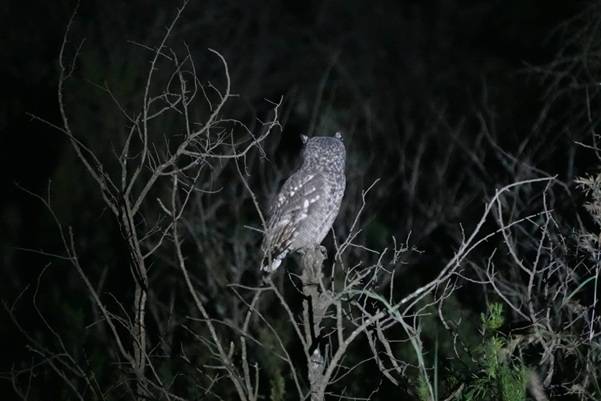
A slightly shy Spotted Eagle Owl (Photo Credit: Saffron Banks)
A visit to Mashobane Secondary School
Towards the end of the week we got to visit one of the local secondary schools. This was an absolute highlight for our students and we could not be prouder of how they completely threw themselves into it. We were fully immersed in African culture on the way to this visit as we got to experience our first South African minibus “taxi”, which are basically like a boombox on wheels! Local music was pounding from the speakers as we partied our way to the school. It turns out that was just the beginning. The students were on their lunchbreak when we got there so we had an opportunity to be shown around the school. We were seriously impressed with the 95 percent pass rate the school had for their A levels, a testimony to the work of the both the teachers and the students. The school has a fabulous strap line of ‘let your hard work define your success’, a goal that is evidently being embraced.

Everyone was so engaged in the lesson, it was really great to see!
After lunch the Harper Adams students got to help with an educational activity, which was a session all about recycling. This was run by a member of the Wild Connection team. We had taken with us a bag full of rubbish from the local area and the high school students were tasked with mapping those types of rubbish to the card the Harper students were holding, which included organic and non-organic waste types. The Mashobane students were great at this task which was followed by a Q&A where Harper students got to test the Mashobane students on their recycling knowledge. This was a feat for the Harper students as they had to come up with increasingly challenging questions to test their counterparts!

Once the education session was over, we were treated to a traditional Zulu dance. The Mashobane students were so incredibly flexible but the Harper students were enthusiastic and put both feet forward when trying to join in. Being immersed in local culture was a real eye-opening experience for our students and there were many MANY selfies taken! Several of the Mashobane students came up to us and thanked us for coming. One of the young ladies said to me they’d never had an international visit before and they were so grateful for us attending. It was an absolute pleasure to be there and we would certainly have spent all day there if we could!

Selfies were the name of the game at the school visit! (Photo credit: Angelica Cuenca Toala)
After the visit to the school we went to visit some of the Zulu ladies in the community. The ladies have a programme of making beautiful hats (called Jabong Hats) from plastic bags that are abandoned in the community. They clean each piece of plastic and then crochet it into a beautiful and sturdy hat that will withstand both the African sun and the suitcase home. The art of turning rubbish into beautiful hats is quite incredible. The students loved them and we purchased many hats! We stayed there for a lunch of samp, beans and corn bread. Delicious! The hospitality of the Zulu community was second to none, and the Harper students just loved playing football with the children!
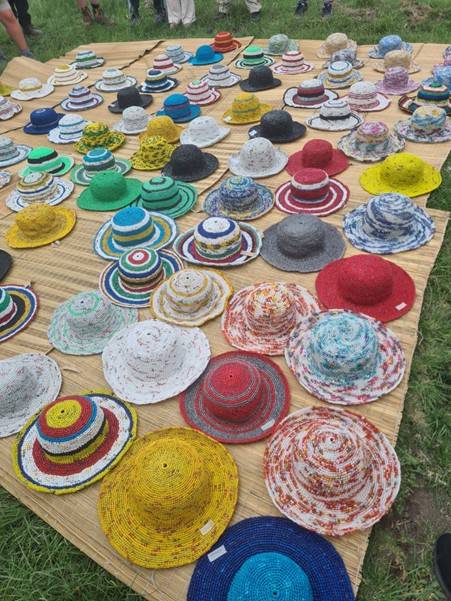
The array of hats being produced by the Zulu ladies (Gogos) as part of the Jabong Hat Project – this helps to reduce plastic waste in the environment while simultaneously generating money for the community and protecting people from the African sun!
Reflection Hill
A personal favourite for me. Our guide Graeme took us, along with his trusty canine side kick Buddy, on a unique visit to a truly beautiful part of the reserve. A meandering walk to the top of a hill, students were led through tall grass, around trees, they walked in a circle humming… they thought about the fact that the path through life is not linear.
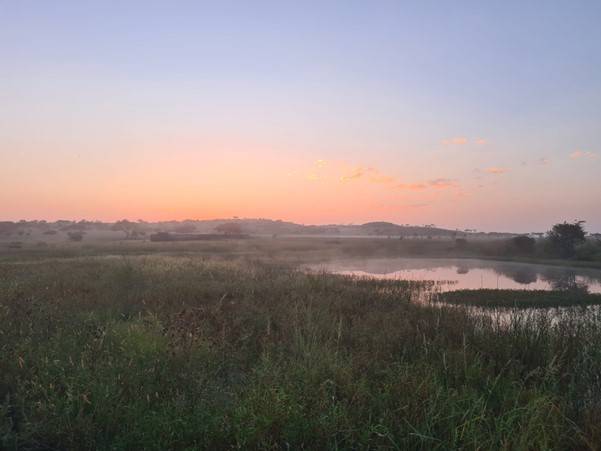
The African sunrise is beyond beautiful
They thought about their own journeys and the challenges they had faced, and they thought about how they still made it to the place they are today. The rocky bit at the top of the hill had a time where we stopped and thought about lost friends and then we passed a lost soul on the way to the highest point. Once there we spent some time admiring the beauty that is the area surrounding Nambiti and reflected on our own lives. It’s so powerful, and it is definitely something we should all do more of in life! The students loved it!
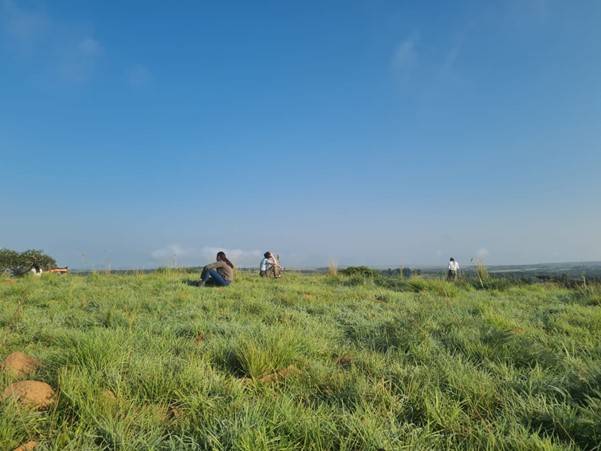
Reflection Hill at Nambiti Game Reserve, a place for quiet reflection, thinking about whatever is important to you
The final night and the last Nambiti Induku
Saying goodbye is the hardest and most emotional time and this year was no exception. During the induku the students reflected on the previous week, and also what this experience had meant for them. Some of the comments on the week included the importance of realising the bigger picture, recognising the privilege they have and how much they enjoyed seeing a different way of life. There was also so much learning, with students remarking they had learned many new animal facts and had ‘an experience they’ll never forget’. Nambiti staff also reflected on the week, with many of them remarking on how awesome our group had been, engaged and full of questions. One of the other guides also said the buzz the group had brought with them helped reignite her passion for guiding, which was an incredible compliment for our crew!
Nambiti and the Wild Connection team had again worked their magic and the students were both sad to be leaving and excited for their next adventure. We were halfway through but there was so much more on the horizon. In the next blog we will start with the stunning walk from Nambiti to Zingela, and celebrating the birthday of one our group!
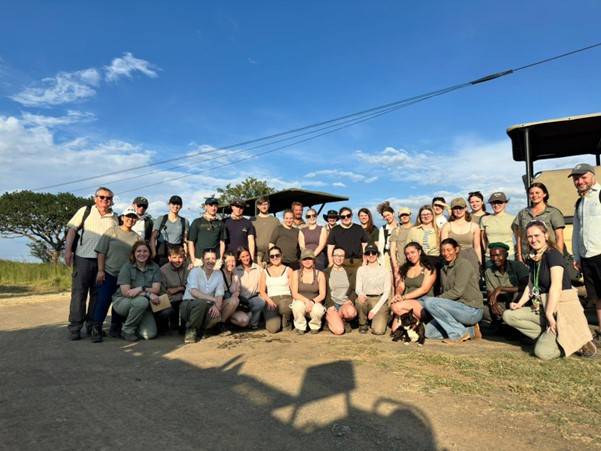
The final photo before the Nambiti journey finished (Photo credit: Angelica Cuenca Toala)

 Driving innovation: why the future of farming is digital
Digital technology and data hold the keys to the future of farming – and offer huge opportunities for the next generation of farmers. …
Posted 11 May
Driving innovation: why the future of farming is digital
Digital technology and data hold the keys to the future of farming – and offer huge opportunities for the next generation of farmers. …
Posted 11 May